

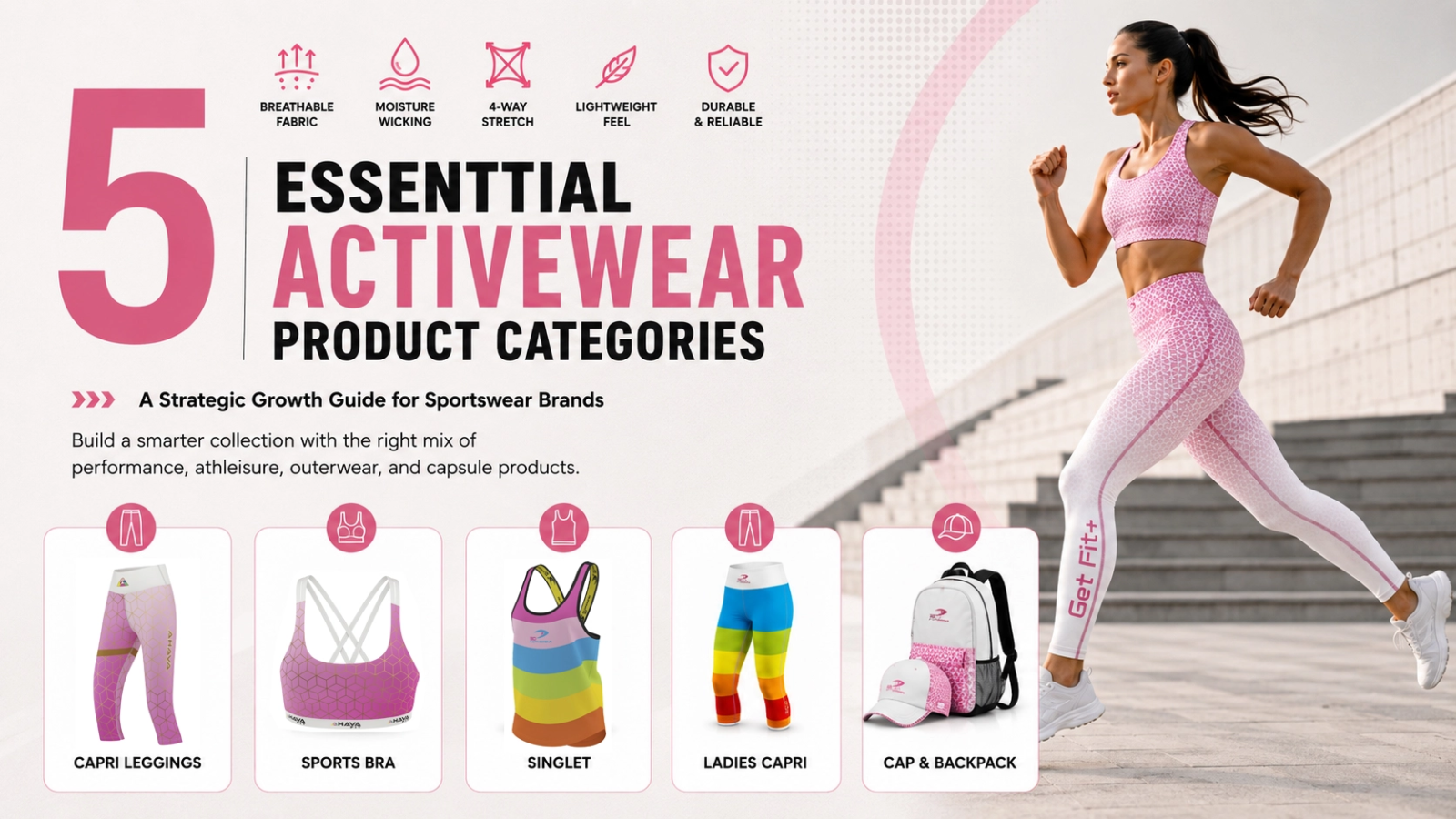
5 Essential Product Categories That Fuel Growth for Activewear Brands
Choosing the right activewear product categories is one of the most important decisions a growing sportswear or fitness brand can make. Strong collections are not built by launching everything at once; they are built by selecting categories that match customer demand, sourcing capability, margins, fit requirements, and the long-term identity of the brand.
This guide breaks down five practical product categories for activewear brands and explains how to source, develop, test, and scale them from a B2B manufacturing perspective.
Quick Answer
The five activewear product categories that can create a strong foundation for growth are: core performance bottoms, high-performance tops and sports bras, athleisure and hybrid pieces, outerwear and layering products, and capsule or limited-edition collections. The best mix depends on your target customer, factory capability, fabric expertise, margin structure, and ability to maintain consistent fit and quality.

Performance Tops & Bottoms

Technical Performance Apparel

Scalable Sportswear Collections
Why Activewear Product Category Strategy Matters
In a crowded activewear market, success is not only about making something visually attractive. A brand needs a product structure that can be manufactured consistently, priced profitably, explained clearly, and expanded without creating unnecessary supply-chain complexity.
This is why choosing the right activewear product categories matters. Every category introduces its own fabric requirements, fit risks, trims, stitching methods, minimum order quantities, testing needs, and logistics considerations. Launching too many categories at once can spread design, sampling, marketing, and purchasing resources too thin.
A Strong Category Should Ideally Do Four Things
- Match a clear customer need.
- Fit the technical capability of your supplier or factory.
- Provide healthy margin potential.
- Support the long-term identity of the brand.
For B2B buyers, sourcing teams, and manufacturers, category strategy is also about repeatability. A well-developed category can be refreshed through color, graphics, fabric updates, trims, and seasonal variations without rebuilding the entire production system from zero.
How to Prioritize Activewear Product Categories
When comparing activewear product categories, score each option against customer demand, expected margin, factory capability, fabric availability, fit complexity, minimum order quantity, and repeat-purchase potential. This creates a more objective basis for deciding which products deserve development budget first.
The strongest activewear product categories are usually the ones your supply chain can reproduce consistently. A category may look attractive on paper, but it should not be scaled until sampling, quality control, delivery timing, and costing are reliable.
Material selection also affects how successfully activewear product categories can scale. Brands evaluating textile safety can review the official OEKO-TEX® STANDARD 100, while brands comparing fiber and raw-material sourcing approaches can explore the Textile Exchange Fiber and Materials Matrix.
Before expanding into new activewear product categories, validate the commercial role of the existing range. Expansion should solve a customer need or create a clear cross-selling opportunity—not simply increase the number of SKUs.
1. Core Performance Bottoms
Core performance bottoms—such as leggings, compression shorts, training shorts, running tights, and fitted gym bottoms—are among the most commercially useful activewear product categories because they combine frequent use, visible branding, and strong opportunities for fabric-led differentiation.
Why Performance Bottoms Matter
- They can generate repeat purchases when fit and comfort are reliable.
- They are highly visible during training and lifestyle use.
- Fabric, compression, stretch, pockets, waist construction, and seam design can differentiate the product.
- Core fits can often be repeated across new colors and seasonal releases.
Implementation Tips
Start with fabric performance. Four-way stretch, moisture management, recovery, opacity, abrasion resistance, and hand feel should be evaluated together rather than treated as isolated claims.
Build global sizing and grading requirements early. Bottoms are highly sensitive to rise, hip shape, inseam, waistband tension, gusset construction, and stretch behavior. A strong sample in one size does not automatically mean the full size range will perform correctly.
Pitfalls to Avoid
- Launching too many silhouettes before one core fit is proven.
- Focusing only on appearance and ignoring movement, recovery, or opacity.
- Changing fabrics without rechecking fit and measurements.
- Using complex trims or pockets that add cost but little customer value.
2. High-Performance Tops and Sports Bras
Performance tops and sports bras are important activewear product categories because they sit close to the body, require careful fit development, and can create strong customer loyalty when comfort and support are consistent.
Why They Matter
- Customers notice fit, comfort, breathability, and seam placement immediately.
- Technical construction can justify stronger price positioning.
- Successful core fits can support multiple fabrics, colors, and collections.
- They pair naturally with bottoms, helping increase basket size.
Implementation Tips
Use engineered ventilation, mesh panels, moisture-management fabrics, ergonomic seam placement, and suitable stretch recovery. For sports bras, define the intended support level and test the design for the movement level it is supposed to handle.
Factory capability is especially important. Some garments may require flatlock machines, elastic application expertise, bonding, lining control, cup insertion, or precise strap construction. Make sure the selected supplier can consistently execute the technical details before scaling volume.
Pitfalls to Avoid
- Underestimating the importance of fit and support.
- Using one construction method for every activity level.
- Leaving inclusive sizing decisions until late in development.
- Ignoring comfort at seams, armholes, straps, and underbust areas.
3. Versatile Athleisure and Hybrid Pieces
Athleisure has expanded the role of activewear product categories beyond the gym. Customers increasingly expect clothing that can move between training, travel, work-from-home, commuting, and casual use.
Why Athleisure Matters
- It widens the addressable market beyond dedicated fitness users.
- It can increase wearing frequency and perceived value.
- It gives brands opportunities to combine technical fabrics with lifestyle styling.
- It creates natural cross-selling with performance products.
Good Hybrid Product Examples
- Performance joggers
- Technical hoodies
- Lightweight zip-ups
- Relaxed pullovers
- Travel-ready stretch pants
- Minimal lifestyle training jackets
The most effective hybrid products balance both sides of the promise. If the garment looks too technical, casual customers may not use it outside training. If it becomes too fashion-focused, performance customers may not trust it during actual activity.
What to Check Before Production
- Does the fabric still look premium after repeated wear?
- Is the silhouette suitable for both training and lifestyle use?
- Do trims and finishes support the price point?
- Can the factory source both performance and heavier lifestyle materials reliably?
4. Outerwear and Layering Pieces
Jackets, windbreakers, lightweight shells, vests, and transitional layers can become valuable activewear product categories because they often carry higher average selling prices and create stronger opportunities for technical features and visible branding.
Why Outerwear Matters
- It can increase average order value.
- It gives the brand a broader seasonal product range.
- It creates space for logos, reflective trims, pockets, panels, and technical features.
- It can help a brand enter running, commuting, travel, and outdoor use cases.
Implementation Tips
Define whether the garment is intended for wind protection, water resistance, warmth, visibility, packability, or everyday layering. These goals affect shell fabrics, lining, zippers, seam construction, coatings, ventilation, and fit.
Outerwear also requires more planning around freight volume, seasonal demand, trims, and factory skill. A supplier that performs well on compression garments may not automatically be the right partner for complex jackets.
Pitfalls to Avoid
- Buying heavy inventory before demand is validated.
- Using technical claims that have not been properly tested.
- Adding too many trims and features that increase cost and production risk.
- Creating outerwear that feels disconnected from the brand’s core fit and visual identity.
5. Capsule Collections and Limited-Edition Drops
Capsule releases and limited drops can complement your core activewear product categories by creating urgency, testing new ideas, and giving loyal customers reasons to return.
Why Capsules Matter
- They create excitement without rebuilding the full range.
- They allow smaller tests of new colors, prints, fabrics, trims, or collaborations.
- They can reveal demand before a concept becomes part of the permanent line.
- They give marketing teams a clear story and launch moment.
Implementation Tips
Keep the product count controlled. A capsule should introduce something new without creating an entirely separate supply chain. Use existing successful blocks where possible, then experiment with graphics, materials, trims, or storytelling.
Before launch, make sure limited quantities, delivery dates, product quality, and collaboration terms are realistic. Scarcity can create demand, but missed delivery promises can damage trust.
Pitfalls to Avoid
- Using limited drops as a replacement for a stable core range.
- Introducing too many new materials at the same time.
- Creating artificial scarcity without a clear product story.
- Failing to capture data from the drop for future product decisions.
How to Build Your Activewear Collection Roadmap
Once you understand the core activewear product categories, the next step is deciding the order in which they should enter your collection. The right roadmap reduces development risk and keeps sourcing resources focused.
Define Positioning
- Performance-first?
- Lifestyle hybrid?
- Premium technical?
- Value focused?
- Sustainability-led?
Choose 1–2 Core Categories
- Match factory strengths
- Match customer need
- Control initial SKUs
- Prioritize repeatability
Build Technical Files
- BOM
- Measurements
- Fabric specification
- Trim list
- Construction details
Pilot & Test
- Fit testing
- Wear testing
- Cost review
- Customer feedback
Scale With Data
- Repeat winners
- Reduce weak SKUs
- Add new colors
- Improve lead times
Maintain Consistency
- Fit
- Quality
- Fabric story
- Brand identity
The goal is not to add categories quickly. The goal is to build a product architecture in which each category has a reason to exist and can be supported by your design, sourcing, quality, inventory, and marketing systems.
A disciplined roadmap keeps activewear product categories connected to real customer demand instead of internal guesswork. It also makes it easier to compare development cost, margin, inventory risk, and sourcing complexity before approving the next launch.
As your activewear product categories expand, reuse proven blocks, trims, fabrics, and quality standards wherever appropriate. Standardization can reduce avoidable development work while keeping the collection visually and technically consistent.
For technical development support, Virtual B2B provides Tech Pack Templates, while product concepts can be presented using 3D Product Visualization.
Metrics and KPIs That Matter
Product decisions should be measured. Once multiple activewear product categories are live, category-level performance can reveal where the business should invest, reduce inventory, improve fit, or renegotiate sourcing.
Do not judge a category only by revenue. A high-revenue category can still create problems if its return rate, discounting, lead time, or production variance is too high.
Review activewear product categories side by side each month or quarter so that strong sales do not hide weak margins, excessive returns, or slow inventory movement. Category-level reporting helps sourcing and marketing teams make decisions from the same data.
Over time, the highest-performing activewear product categories should receive more development attention, while weak categories should be improved, reduced, repositioned, or removed.
Why This Product Category Strategy Works
A focused category strategy works because it reduces complexity while giving customers a coherent reason to understand the brand. Strong activewear companies usually become known for something before they become known for everything.
- Fewer core categories allow better fit and quality control.
- Factories can repeat successful constructions and improve efficiency.
- Marketing messages become clearer.
- Inventory decisions become easier to measure.
- New fabrics and trims can be tested through controlled capsules.
- Successful blocks can be extended into colors and seasonal updates.
This does not mean a brand should stay small forever. It means expansion should follow evidence. When the first activewear product categories are commercially proven, the brand can add new layers of complexity from a stronger operational base.
Common Mistakes Activewear Brands Should Avoid
Launching Too Many Categories at Once
Ten categories can create ten different sets of fabrics, fits, trims, factory processes, and inventory risks. Launch fewer categories and execute them better.
Ignoring Fit and Fabric Consistency
Customers expect the brand’s sizing and quality standards to feel consistent. Switching suppliers, fabrics, or blocks without proper testing can quickly damage trust.
Choosing Categories the Factory Cannot Execute Well
Supplier capability should influence product architecture. A factory that excels at leggings may not be the right partner for bonded technical jackets or complex intimate construction.
Making Decisions Without Data
Track category-level sales, returns, margins, repeat purchase, and lead time. Do not continue buying a category simply because the team personally likes it.
Neglecting Product Storytelling
Product categories are not only manufacturing units. Each one should reinforce the brand promise and help customers understand what the company stands for.
Frequently Asked Questions About Activewear Product Categories
What are the best activewear product categories for a new brand?
A new brand should usually begin with one or two categories that match its target customer and manufacturing strengths. Performance bottoms, training tops, sports bras, and selected hybrid pieces are common starting points, but the right answer depends on the brand’s market and factory capability.
How many product categories should an activewear brand launch with?
There is no universal number, but launching a focused range is generally easier to sample, test, finance, and market than launching many unrelated categories. One or two strong core categories can provide better learning before expansion.
Which activewear category has the strongest repeat-purchase potential?
Performance bottoms, tops, and sports bras can create repeat purchases when fit, comfort, and quality are consistent. However, actual repeat behavior should be measured from your own customer data.
When should an activewear brand add outerwear?
Outerwear is best added when the brand has validated core demand, understands its seasonal market, and has access to suppliers capable of handling shells, linings, technical trims, zippers, and more complex construction.
Are capsule collections good for activewear brands?
Yes. Capsules can test new colors, prints, collaborations, fabrics, and trims with less commitment than a full collection. They work best when they complement a reliable core line rather than replace it.
How can 3D product visualization help activewear development?
3D visualization can help present silhouettes, colorways, product details, and collection concepts before or alongside physical samples. It can also support product presentations, marketing assets, and internal approvals.
Final Thoughts: Build a Product Architecture, Not Just a Collection
Choosing the right activewear product categories is a strategic decision that affects design, sourcing, manufacturing, inventory, marketing, and customer loyalty. The strongest collection is not necessarily the one with the most SKUs; it is the one in which each product category has a clear commercial role.
Start with categories that match your customer and supplier strengths. Build accurate tech packs, validate fit and performance, test the market, track category-level data, and expand only when the existing range proves it can support the next step.
If you need professional support with product visualization, technical presentation, or digital customization, explore Virtual B2B’s 3D Product Visualization and 3D Kit Builder solutions.
Build Your Next Activewear Collection With More Clarity
Virtual B2B helps apparel and sportswear brands present products professionally through 3D visualization, technical product development support, digital customization, and eCommerce solutions.
Discuss Your Activewear Project