

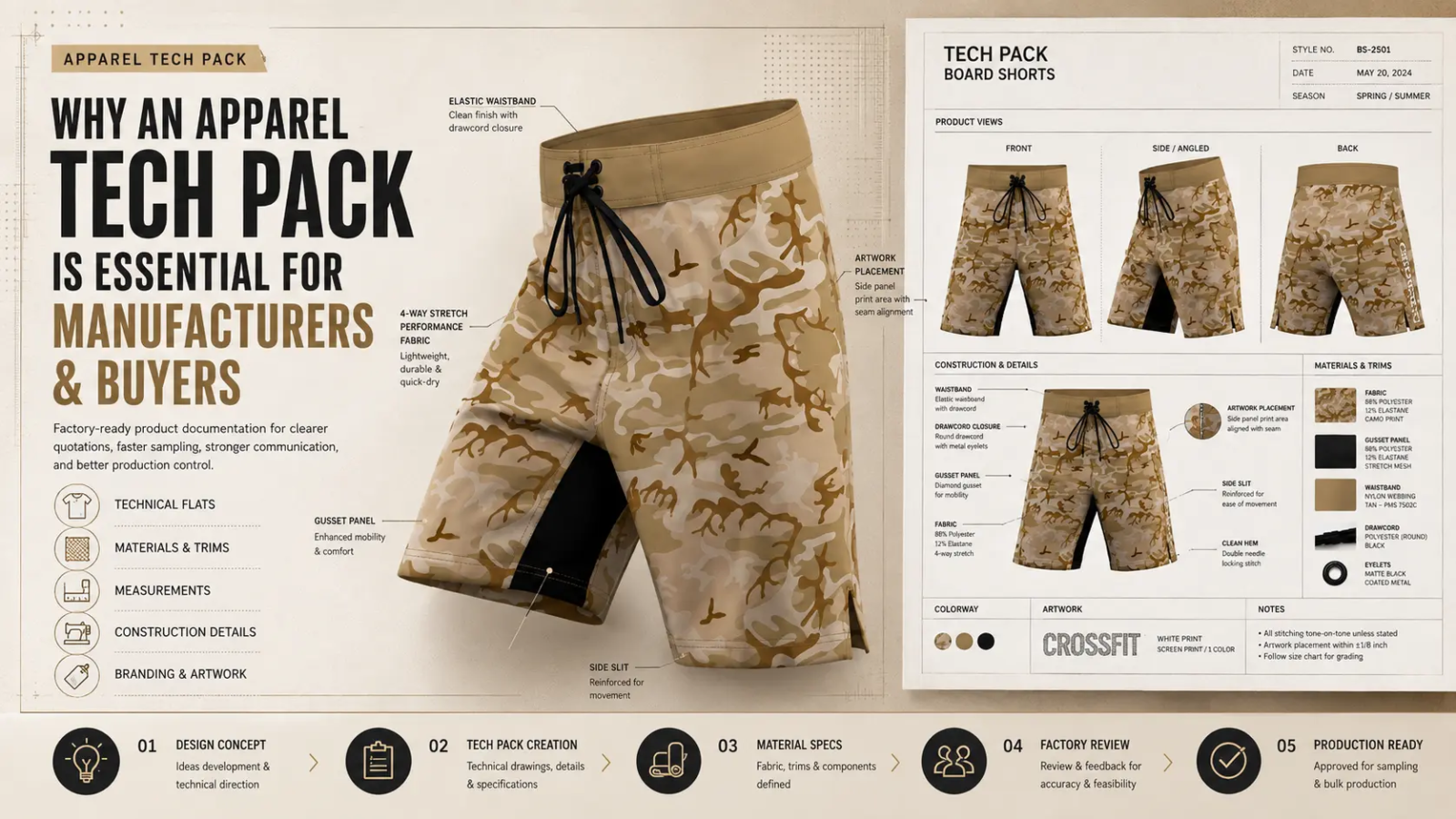
An Apparel Tech Pack Is More Than a Document. It Is the Blueprint for Production.
An apparel tech pack turns a design idea into clear manufacturing instructions. It gives buyers, designers, merchandisers, pattern makers, sample rooms, sourcing teams, and factories a shared reference for what the garment should be, how it should fit, which materials should be used, and how important details should be constructed.
Without that shared reference, factories are forced to interpret missing information. That can create avoidable sampling rounds, inconsistent quotations, unclear approvals, fit problems, and confusion when the style moves from development into bulk production.
Quick Answer
A professional apparel tech pack should clearly communicate the garment’s technical drawings, measurements, materials, trims, construction, colorways, artwork placement, labeling, packaging, and revision history. For buyers, it improves control and comparability. For manufacturers, it reduces assumptions and gives the production team a clearer basis for quotation, sampling, sourcing, and quality control.

Product Design & Fit Communication

Sportswear Construction & Specifications

Factory-Ready Product Documentation
What Is an Apparel Tech Pack?
An apparel tech pack is a structured technical document used to communicate how a garment should be developed and manufactured. It converts the creative concept into production information that can be used by people who were not present when the original design was created.
A sketch alone can show the visual idea, but it usually cannot answer every production question. A factory may still need to know the exact fabric composition, weight, trim specification, seam type, stitch details, logo dimensions, garment measurements, tolerance, packaging method, label position, and size grading.
Think of It as a Shared Technical Language
The strongest apparel tech pack does not simply look professional. It removes ambiguity. A designer should be able to show the intended product, while the factory should be able to understand what must be sourced, sampled, measured, assembled, checked, and approved.
This becomes especially important when brands source internationally. Teams may be working across different time zones, languages, production systems, and supplier networks. Clear written and visual specifications reduce dependence on memory, informal chat messages, and verbal interpretation.
1. An Apparel Tech Pack Supports More Accurate Quotations
A factory cannot quote a product accurately if critical information is missing. The cost of an apparel style depends on variables such as fabric type, consumption, GSM, trims, printing, embroidery, zipper quality, construction complexity, stitching, packaging, order volume, and finishing.
A detailed apparel tech pack gives the manufacturer a more consistent basis for estimating these inputs. It also helps a buyer compare quotations because competing factories are reviewing the same specification rather than quoting different interpretations of the garment.
Why This Matters for Buyers
- Quotes are easier to compare.
- Material substitutions become more visible.
- Unexpected cost changes are easier to investigate.
- Design decisions can be adjusted before production commitments are made.
Why This Matters for Manufacturers
- The costing team receives clearer requirements.
- Fabric and trim sourcing can begin from defined specifications.
- Construction complexity can be reviewed before confirming a price.
- Questions can be raised before the sample room begins work.
2. A Tech Pack Makes Sampling Faster and Clearer
Sampling is where an idea becomes a physical product. If the information provided to the factory is incomplete, the first sample may reflect the factory’s assumptions rather than the buyer’s intent.
A complete apparel tech pack gives the sample room a clearer starting point. Technical flats explain the silhouette and construction. Measurement charts define the target size. BOM pages define materials. Artwork pages identify branding. Comments and revisions document what should change after each fitting.
A well-managed revision process is often as important as the original document. A technically strong pack that is not updated can still create problems if one department is using version three while another team is using version five.
3. An Apparel Tech Pack Improves Fabric and Trim Control
Materials define much of a garment’s appearance, performance, cost, and manufacturing behavior. Two fabrics that look similar in a photograph can perform very differently in stretch, recovery, shrinkage, weight, drape, colorfastness, abrasion, and hand feel.
The Bill of Materials section of an apparel tech pack should make the material requirements as clear as practical. Depending on the product, that may include fabric composition, GSM, usable width, finish, color reference, lining, elastic, zippers, snaps, drawcords, labels, thread, interlining, reflective material, and packaging components.
Useful Material Information
- Fabric composition and construction
- Target GSM or weight range
- Color or approved color standard
- Finish or coating requirements
- Stretch direction where relevant
- Trim dimensions and quality level
- Supplier or approved reference where applicable
Brands evaluating textile material systems can also review resources from Textile Exchange , while textile product-safety requirements may involve standards or certifications relevant to the target market and material. The exact compliance route should be confirmed for the product and country where it will be sold.
4. It Creates Stronger Fit and Measurement Control
Fit is one of the most sensitive areas of apparel development. A garment can look excellent in a render or presentation but fail commercially if the sizing, ease, proportion, mobility, or grading is inconsistent.
A professional apparel tech pack typically includes a measurement specification with clearly defined points of measurement (POMs), target measurements, tolerances, base size, and grading information where required.
For broader reference, ISO publishes standards covering clothing sizing and anthropometric definitions. For example, ISO 8559-1 describes anthropometric definitions used for body measurement in clothing product development. A brand still needs to develop the garment measurements and fit appropriate for its own customer, silhouette, fabric, and market.
A Strong Measurement Page Can Include
- Base sample size
- Point-of-measurement names
- Measurement diagrams
- Target garment measurements
- Plus/minus tolerances
- Grading rules or graded specifications
- Fit comments and approved revisions
5. It Clarifies Construction Before Bulk Production
A garment is more than its silhouette. Seam allowance, stitch type, seam position, pocket construction, zipper insertion, hem finish, reinforcement, binding, bartacks, ventilation, lining, and edge finishing all affect the final product.
The construction pages of an apparel tech pack should explain important details that cannot be communicated by the main front and back drawings alone. Close-up callouts, sectional sketches, annotations, and reference images can all be useful when they are specific and unambiguous.
Do Not Leave High-Risk Details to Interpretation
- Pocket opening and pocket-bag construction
- Zipper type, length, position, and puller
- Elastic width and finished tension
- Reflective tape or transfer placement
- Seam or stitch specification
- Ventilation and mesh-panel construction
- Hood, cuff, hem, and collar details
6. It Controls Logos, Artwork, Labels and Branding Placement
Branding details often look simple on a concept board but need precise instructions in production. A logo may be printed, embroidered, heat transferred, woven, reflective, debossed, or applied as a patch. Each method needs different dimensions, artwork files, colors, placement references, and manufacturing steps.
An apparel tech pack should show the location, size, orientation, application method, and approved artwork reference for each branded element. It should also define care labels, size labels, main labels, hangtags, and other brand components when they are part of the product.
Artwork Pages Should Be Specific
- Logo width and height
- Distance from defined seams or edges
- Color reference
- Application technique
- Artwork file name or version
- Orientation and repeat information for patterns
7. The Tech Pack Becomes a Quality-Control Reference
Quality control works best when the standard being checked is documented. If a buyer and factory have different ideas about the approved measurement, trim, construction, or artwork position, the inspection team may have no clear reference for deciding what is acceptable.
A finalized apparel tech pack, together with approved samples and any agreed quality standards, can provide a practical reference for inline checks, final inspection, and production review.
The document should not be treated as the only quality system. Material testing, workmanship standards, approval samples, inspection plans, and compliance requirements may also be necessary depending on the product and market. The value of the tech pack is that it connects many of those requirements to one identifiable style.
8. It Improves Communication Between Buyers and Manufacturers
International apparel development may involve designers, sourcing agents, merchandisers, technicians, pattern teams, fabric mills, printing units, embroidery suppliers, sample rooms, and production factories. Information can easily become fragmented across email, messaging apps, spreadsheets, and verbal discussions.
An apparel tech pack creates a central reference that helps different departments discuss the same version of the product. Instead of writing “make the pocket a little higher,” a revision can specify the approved measurement or updated placement on the technical page.
Better Communication Means Fewer Assumptions
The objective is not to eliminate questions. Good factories should ask questions when information is unclear. The objective is to make those questions specific, traceable, and easier to resolve before expensive production stages begin.
9. A Tech Pack Makes Scaling and Reordering Easier
Successful styles are often reordered, recolored, updated, or moved between suppliers. Without structured technical documentation, the business may depend too heavily on one individual, one sample, or one factory’s internal knowledge.
A controlled apparel tech pack helps preserve product information as the business grows. If the style is reordered six months later, the team can review the approved specification rather than rebuilding the product history from messages and memory.
This is particularly useful when introducing additional colors, new size ranges, regional versions, or secondary suppliers. A good document does not guarantee that every factory will produce an identical result, but it gives each supplier a far clearer technical starting point.
What a Professional Apparel Tech Pack Should Include
The exact structure varies by product and company, but a professional apparel tech pack commonly includes the following information.
Virtual B2B provides Tech Pack Templates and product-development presentation support. Brands can also combine technical documentation with 3D Product Visualization to communicate product concepts visually before or alongside physical sampling.
A Practical Apparel Tech Pack Workflow
An effective apparel tech pack should evolve with the product. The following workflow keeps design, technical development, and manufacturing information connected.
Define the Product
- Customer
- Use case
- Target price
- Silhouette
- Key features
Create Technical Flats
- Front & back views
- Detail callouts
- Construction notes
- Artwork positions
Define Materials
- Main fabric
- Contrast fabric
- Trims
- Labels
- Packaging
Build Measurements
- POMs
- Base size
- Tolerances
- Grading
Sample & Review
- Fit comments
- Material approvals
- Construction changes
- Cost review
Update & Approve
- Revision control
- Final specifications
- Approved sample
- Production handoff
Common Apparel Tech Pack Mistakes to Avoid
Sending Only Reference Photos
Inspiration images can help explain an idea, but they are not a replacement for measurements, construction instructions, materials, and product-specific details.
Using Vague Material Descriptions
“Premium stretch fabric” is not enough for reliable sourcing. Define the technical requirements that matter for the product and approve actual production materials before bulk manufacturing.
Missing Tolerances
Manufacturing has natural variation. A measurement specification without realistic tolerances can make quality decisions difficult. Tolerances should be appropriate to the garment, construction, fabric behavior, and required quality level.
Not Updating Revisions
If the sample is approved with a shorter zipper, different pocket position, or revised measurement, the apparel tech pack should be updated. Otherwise the bulk team may follow an old instruction.
Adding Too Much Unstructured Information
More pages do not automatically create a better document. Information should be organized so the factory can quickly locate the measurements, materials, artwork, and construction details relevant to its task.
Ignoring Factory Feedback
A tech pack is not a one-way communication tool. Experienced manufacturers may identify construction, sourcing, machinery, cost, or production issues that should be resolved before bulk production.
Frequently Asked Questions About Apparel Tech Packs
What is an apparel tech pack?
An apparel tech pack is a technical specification document that communicates how a garment should be developed and manufactured. It commonly includes technical drawings, materials, trims, measurements, construction details, colorways, artwork, labels, packaging, and revisions.
Does a clothing brand need a tech pack before contacting a manufacturer?
A complete tech pack is extremely useful when requesting accurate development and costing, although some manufacturers can begin early discussions from less complete information. The clearer the technical requirements are, the easier it is for a factory to understand the project and identify missing information.
Who should create the apparel tech pack?
It may be created by a technical designer, apparel designer, product developer, garment technician, or specialized service provider. What matters is that the person understands both the design intent and the technical information the factory needs.
What is the difference between a tech pack and a tech flat?
A technical flat is a detailed drawing of the garment. It is usually one component of the larger apparel tech pack, which may also include the BOM, measurements, grading, construction, artwork, colorways, packaging, and revision information.
Can a tech pack reduce sampling mistakes?
A clear tech pack can reduce avoidable assumptions and gives the sample room better information, but it does not eliminate the need for sampling, fit review, material approval, communication, testing, and quality control.
Should the tech pack be updated after fitting?
Yes. Approved fit, construction, material, artwork, and measurement changes should be incorporated into the current document so later sampling and production teams use the correct information.
Can 3D product visualization replace a tech pack?
No. 3D visualization and tech packs serve different purposes. 3D can help communicate appearance, colorways, presentation, and design intent, while the apparel tech pack documents the technical information required for development and manufacturing. Used together, they can create a stronger product-development workflow.
Final Thoughts: Make the Tech Pack the Single Source of Product Truth
An apparel tech pack is valuable because it connects design intent with manufacturing execution. It gives buyers more control over what they are requesting and gives factories clearer information about what they are expected to source, sample, cost, construct, measure, and inspect.
The best tech packs are not static files created once and forgotten. They are maintained throughout development so that approved changes are reflected in the document before the product reaches bulk production.
For manufacturers, clearer documentation reduces dependence on assumptions. For buyers, it creates a more reliable basis for comparing factories, managing revisions, checking samples, preserving product knowledge, and scaling successful styles.
If you need support preparing technical apparel documentation, explore Virtual B2B’s Tech Pack Templates and 3D Product Visualization services.
Turn Your Apparel Design Into Factory-Ready Information
Virtual B2B helps apparel and sportswear businesses communicate products more professionally through technical presentation, 3D product visualization, digital customization, and eCommerce solutions.
Discuss Your Apparel Project